
The Real Price of Ballistic Missile Defenses
A news story misstates the cost of US missile defense efforts, prompting a response from our resident budgetary expert.
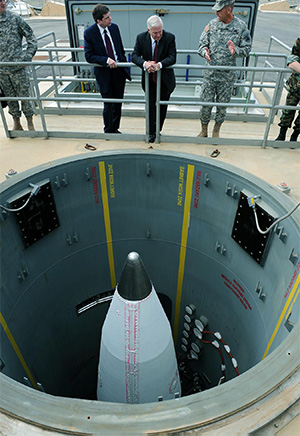
Alaska Senator Mark Begich, center left,
and former Secretary of Defense Robert M. Gates, center right,
listen to a briefing on a ground-based interceptor missile
silo at Fort Greeley, Alaska, June 1, 2009.
(Department of Defense/Master Sgt. Jerry Morrison, U.S. Air Force)
Src: http://cryptome.org/eyeball/nuclear-silos/nuclear-silos.htm
In a story today on the ongoing debate over missile defense, Politico stated that after “60 years and $35 billion” the United States has yet to deploy an effective ballistic missile shield. I’ve spent a lot of time reviewing the history and cost of the US quest for invulnerability to nuclear attack, and $35 billion doesn’t even come close to our investment in technological solutions to what is ultimately a political problem. (Even the Missile Defense Agency lists total appropriations since fiscal year 1985 at $149.5 billion—in unadjusted dollars. Politico has now corrected its story to reflect the data in this article.)
Fourteen years ago, as part of the first and so far only comprehensive study of the costs of the US nuclear weapons program, my colleagues and I took a very close look at all historical missile defense efforts. We found that between 1962 and 1996, the United States spent nearly $100 billion on missile defense programs (in inflation-adjusted 1996 dollars), including the short-lived Safeguard system and the Strategic Defense Initiative (SDI) and its successors. (US missile defense efforts actually started shortly after World War II, but owing to the somewhat haphazard budgeting system used by the Department of Defense until 1961, there are very few useful records from that period.) Note that this figure does not include the cost of developing, testing, and manufacturing the two nuclear warheads used on the Spartan and Sprint missiles, which were part of the Safeguard system.
If we adjust all those costs to today’s dollars and include subsequent appropriations since 1996 through this fiscal year, total costs to date are at least $274 billion and counting. Since President Ronald Reagan launched SDI in 1983—which is when many people erroneously believe US work on missile defenses actually began—the amount is $209 billion.
Notwithstanding North Korea’s fourth failed test of a long-range ballistic missile, some US elected officials are now calling for increasing spending on missile defense programs (currently $8.4 billion a year). The widespread lack of understanding by political leaders and the general public of the significant sums we have already sunk into these efforts over more than six decades is one reason why.
Stephen I. Schwartz is the editor of the Nonproliferation Review and WMD Junction, and the editor and co-author of Atomic Audit: The Costs and Consequences of U.S. Nuclear Weapons Since 1940.